Sunday, 12 June 2016

Tuesday, 7 June 2016
A check in kiosk is one way for hotel management to collect data on customer preferences.

Competition is fierce in the hospitality industry. Whether it’s a hotel chain, an airline, a cruise ship company or a restaurant, businesses are utilizing the most up-to-date systems for improving guest satisfaction. Technology and other means can be used to learn what customers prefer, enabling a business to excel at providing top-notch service.
Specialized Software Systems
A significant number of hospitality businesses -- one survey of a group of marketers put the figure at 94.3 percent -- attempt to increase productivity by learning their guests’ predilections. The use of special data collection software is an effective means of discerning guest satisfaction. Several types of software on the market can serve this purpose. For restaurants, for example, computer programs can glean data from people who make reservations, such as the type of wine preferred or any indication of allergies. Bartenders can track customers' drink orders and use the information to have a customer's favorite drink prepared even before it's been ordered. Many hotels employ similar software to capture information ranging from which board games children in a family enjoy to details about a pet that accompanies the family.
System Variety
Not all hospitality businesses use specialized computer software to record data. Some ask guests to fill out a printed survey card upon arrival, during their stay or upon departure. Social media outlets also are useful tools to learn customer preferences. Businesses encourage their customers to post comments about their experiences. Online surveys are also popular, as are other online systems enabling customers to write reviews about their visits. Databases created using readily available spreadsheet programs may be used to compile collected information, which is reviewed in advance of every subsequent visit. For example, if a hotel visitor indicates on a survey card that he is allergic to feathers, the hotel may provide a nonallergenic alternative -- an accommodation likely to ensure his return.
Customer Service is Key
Regardless of the collection method used, keep in mind the reason for doing so: to ensure exceptional customer service. Knowledge acquired about a customer is useless unless it enhances personal service. Systems that engage customers include customer loyalty programs, such as one that offers discounts or other amenities for repeat business. For example, an airline might track preferred seating information about its customers. After pertinent information is relayed to airline personnel, they can begin favorably seating customers where the data has indicated. The customers, in turn, may begin to prefer flying on that particularly accommodating airline, collecting mileage points or another type of loyalty premium for doing so.
Know the Limits
There can come a point when a business should draw the line on data collection. For example, some businesses use the Internet to search for more personal information about arriving guests in an attempt to be more obliging. One hotel searched online for -- and found -- a photo of a family of arriving guests, framed it and placed it in the room as a welcoming gift to encourage the guests to feel more at home. That might be appreciated by some, but it could be perceived by others as an egregious invasion of privacy.
Sunday, 29 May 2016
Smart beacon is the next big thing!
Beacon is a product that provides two-ways communication with nearby
Bluetooth-enabled smartphones; beacons went main stream two years ago.
Retailers led the way in experiment with the technology, main point to
use beacon to track shopper’s habits and send promotional messages to
consumers. In US, big names in retail, including Target, Wal-Mart, and Macy’s
have employed beacon technology in their stores.
Beacons have become extensive that business insider’s BI intelligence projected that beacons would create $40 billion in retail sales in the United States in 2016. Beacon is a deliberately conspicuous device designed to attract attention to a specific location. Besides to retailers, restaurants, airports and museums have employed beacons successfully. In the same time, the hospitality industry has been slow to test with this technology. Some major chains are also beginning to see how beacons can be used to increase their shop’s profits. Marriott placed beacons at hotel hot-spots such as restaurants, spas and bars. Guests with the Marriott App on their phones are enabled to receive any promotional messages related with Marriott once they're approaching near to the beacons' transmission area. For instance like discounted spa services and restaurant deals will appears on the guests' phones through the Marriott App when the guests are approaching near to the beacons. In another word, the information related to the Marriott Hotel will be send to the guests' phones (who had installed with Marriott App) through the work of beacons which are all place at the hotel's hot-spots.
Starwood Hotels used a different way to use beacons, placing them near to the entrances, at 30 locations to streamline the check-in process. When the guests entered, the beacons will receive the information from their smartphones, which allowed the concierge to greet the guests by name. Beacons placed near hotel room doorways notified housekeeping staff when guests were not in their rooms. Hospitality industry innovators will be quick to find out other applications for beacons. Beacons can be used to find out the hotel within the area, or hotel can provide guests just entering their room with the information on room features, how to order the room services, or hotel spa’s services and so on. Because beacons offer two-way communication, so retailers can use it to gather data on the guest’s habits. Hotel also can determine where the guests are spending most of their times in the hotel and when are the peak hour for the fitness room, pool or hotel bar.
In conclude, beacons are helpful for the consumers and retailers. Consumers can use them to check the prices, the location of the attraction, and the information of the product and so on. Retailers can use beacons to collect the data such as the consumer’s habits, interest, favorite and so on. This product is essentially effective for both of them. It is also the most convenient equipment for the consumers and retailers to collect the information that they wanted.
Video taken from :
https://www.youtube.com/watch?v=SrsHBjzt2E8
Beacons have become extensive that business insider’s BI intelligence projected that beacons would create $40 billion in retail sales in the United States in 2016. Beacon is a deliberately conspicuous device designed to attract attention to a specific location. Besides to retailers, restaurants, airports and museums have employed beacons successfully. In the same time, the hospitality industry has been slow to test with this technology. Some major chains are also beginning to see how beacons can be used to increase their shop’s profits. Marriott placed beacons at hotel hot-spots such as restaurants, spas and bars. Guests with the Marriott App on their phones are enabled to receive any promotional messages related with Marriott once they're approaching near to the beacons' transmission area. For instance like discounted spa services and restaurant deals will appears on the guests' phones through the Marriott App when the guests are approaching near to the beacons. In another word, the information related to the Marriott Hotel will be send to the guests' phones (who had installed with Marriott App) through the work of beacons which are all place at the hotel's hot-spots.
Starwood Hotels used a different way to use beacons, placing them near to the entrances, at 30 locations to streamline the check-in process. When the guests entered, the beacons will receive the information from their smartphones, which allowed the concierge to greet the guests by name. Beacons placed near hotel room doorways notified housekeeping staff when guests were not in their rooms. Hospitality industry innovators will be quick to find out other applications for beacons. Beacons can be used to find out the hotel within the area, or hotel can provide guests just entering their room with the information on room features, how to order the room services, or hotel spa’s services and so on. Because beacons offer two-way communication, so retailers can use it to gather data on the guest’s habits. Hotel also can determine where the guests are spending most of their times in the hotel and when are the peak hour for the fitness room, pool or hotel bar.
In conclude, beacons are helpful for the consumers and retailers. Consumers can use them to check the prices, the location of the attraction, and the information of the product and so on. Retailers can use beacons to collect the data such as the consumer’s habits, interest, favorite and so on. This product is essentially effective for both of them. It is also the most convenient equipment for the consumers and retailers to collect the information that they wanted.
Video taken from :
https://www.youtube.com/watch?v=SrsHBjzt2E8
Wednesday, 25 May 2016
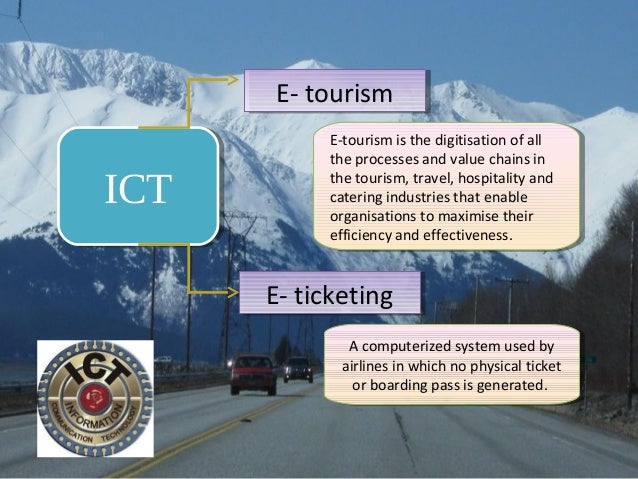
ICTs (Information and communication technology) in the travel and tourism industries
The travel industry already uses a wide range of ICT systems. The importance of ICTs lies less in the technology itself than in its
ability to create greater access to information and communication in
underserved populations.The Internet in particular allows them to demonstrate their competencies
widely as well as to communicate directly with their prospective
customers. Increasingly, intranets are used to offer user-friendly
access to employees of organisations, as well as extranets which provide
authorised partners with the ability to use company data to transact
online. In addition, several internal-management applications facilitate
the strategic and operational management and marketing of travel
organisations.
ICTs support all business functions and are critical for operating in the travel industry as a whole. Few other industries rely on so many partners to collaborate closely for delivering their products and few other value chains are as elaborate as the one for travel. ICTs provide the tools to search for meaningful and profitable niche market segments, to identify value added components for the product and to promote differentiated products through specialised media to particular market segments. Cost effectiveness and flexibility are critical assets contributed by ICTs in this process, as they assist cost reductions and maximise efficiency. The influence of ICTs on travel organisations is pervasive, as information is critical for both day-to-day operations as well as the strategic management of organisations. On the strategic level, travel organisations have to continuously assess all elements of their external environment, as well as their competition and customer needs, and consequently, adapt themselves in order to enhance their competitiveness. Using ICTs, tourism organisations can differentiate their product customising the final product and adding value according to individual requirements.
ICTs support the strategic management of travel organisations by empowering long-term decision making and by providing a platform for collaboration and transactions between partners. They also help the entire industry to operate by empowering internal processes, co-ordinating partners, as well as by interacting with prospective travellers and the general public. As a result, the recent ICT developments have revolutionised the entire system and have profound implications for both the strategic and tactical management of travel organisations. More importantly they have dramatically changed the industry structure and altered the competitiveness of all players in the marketplace.
Source from : http://epubs.surrey.ac.uk/1120/1/fulltext.pdf

ICTs support all business functions and are critical for operating in the travel industry as a whole. Few other industries rely on so many partners to collaborate closely for delivering their products and few other value chains are as elaborate as the one for travel. ICTs provide the tools to search for meaningful and profitable niche market segments, to identify value added components for the product and to promote differentiated products through specialised media to particular market segments. Cost effectiveness and flexibility are critical assets contributed by ICTs in this process, as they assist cost reductions and maximise efficiency. The influence of ICTs on travel organisations is pervasive, as information is critical for both day-to-day operations as well as the strategic management of organisations. On the strategic level, travel organisations have to continuously assess all elements of their external environment, as well as their competition and customer needs, and consequently, adapt themselves in order to enhance their competitiveness. Using ICTs, tourism organisations can differentiate their product customising the final product and adding value according to individual requirements.
ICTs support the strategic management of travel organisations by empowering long-term decision making and by providing a platform for collaboration and transactions between partners. They also help the entire industry to operate by empowering internal processes, co-ordinating partners, as well as by interacting with prospective travellers and the general public. As a result, the recent ICT developments have revolutionised the entire system and have profound implications for both the strategic and tactical management of travel organisations. More importantly they have dramatically changed the industry structure and altered the competitiveness of all players in the marketplace.
Source from : http://epubs.surrey.ac.uk/1120/1/fulltext.pdf
Picture taken from :
Robotic Butlers as helpers at Aloft Hotel in Cupertino
Robots are everywhere including wandering around your hotel. Robots are helping human to share the responsibility of the work and save the time. A hotel in California's Silicon Valley is trying to appeal to the most tech-savvy of customers, utilizing robots, in lieu of humans to deliver towels and other necessities to its guests. By adopting robots as helpers will relatively generates some pros and cons for the organizations. For example, for pros, the organization can save their labor cost in hiring and training the new employees as they are using robots as their helpers for the existing employees in the hotels. The robots only require the engineers to set the programme then it will automatically perform the things that you have programmed into the system. It does save a lot of time compared to train the new employees. On the other hand, for cons, the robots might broke down sometimes so it will cause some repairing costs on the robots. This kind of repairing cost will often cost a lot due to the special design of the robots, internally and externally, it requires professional mechanical to repair it and it's hard to find one.
In Cupertino, California, a hotel named The Aloft Hotel has announced that it will be training two robotic "Botlrs," named ALO, made by Savioke. Their design was inspired by Star Wars' R2D2.
"It's something that's very Silicon Valley. It's very novel and I think it's the future," Steve Cousins, CEO and co-founder of the company, told CBS San Francisco.
 |
| Robotic Butler in The Aloft Hotel |


Pictures taken from :
The robotic butlers, built by Savioke, are able to perform tasks in the front of the house and the back of the house, as well as navigate around guests and use elevators. For the most part, it seems that the Botlrs will be delivering amenities to guest rooms in lieu of actual humans, “freeing up existing talent’s time and allowing them to create a more personalized experience for guests.”
When a guest calls the front desk asking for something, let's say a bottle of water and a toothbrush, employees load up the basket up top, the room number is programmed and ALO is on its way. Once it arrives, the guest can enter a rating on its touchscreen or tweet a "tip".
Using a combination of sonar wave technology, lasers and cameras, the "botlr" avoids obstacles, as well as humans. It can also communicate with the hotel's elevators using WiFi.
"Instead of having a runner up there, you would have a robot coming up to the guest room," Izumi Yaskawa, Savioke's Strategic Ambassador, said.
Based on the response to this trial program, robotic butlers may be deployed to each of the 100 Aloft Hotels around the world in 2015, Brian McGuinness of Starwood, the chain's parent company, told TechCrunch.
The Aloft is just the latest San Francisco area hotel to experiment with cutting-edge technology. In March, the local Personality Hotels announced a program that allows guests to use their smartphones to unlock their hotel room doors.
Video taken from :
Tuesday, 24 May 2016
Technology Trends Revolutionising The Hospitality Industry. Multiple facilitations of new technology in Hospitality (Tourism) Industry. Social Media aspect

It has become one of the main sources of information for people researching holidays, hotels and leisure facilities. It's an apps that are providing travel advice for the travelers. This app allows travelers to check on the available hotels which are located in the places that they want to travel and also provide them some information that are regarding to the hotels such as the prices per night. Besides, this apps also will allows the users to leave down their comments that they have regarding to the particular hotel/restaurants. The comments allows travelers to measure if it is worth staying/dine-in or not. Travelers can get a better picture of that place by looking at the comments that the previous users have left. Other than hotels, this apps (Trip Advisor) also provide information that are regarding to the dine-in locations which are the restaurants. Travelers can use the apps to search on the near by restaurants if they are having some difficulties on finding one in the travel location. It's one of the apps that are recommended for most of the travelers to use as it's easy to access, this apps makes it easier for the travelers to search on the locations as well as booking a flight!
With this apps, travelers can save a lot of efforts as they no longer have the needs to call in to the particular hotel to book a room and ask for the information regarding to the rooms as it ( Trip Advisor ) will allows travelers to easily access to the information of the rooms and book their room online with just a "TAP" with your finger on this particular apps. This apps contains a lot of information regarding to the hotels, restaurants and leisure facilities, so travelers can straight away compare the prices within one to another and make their decisions. By using this kind of apps, travelers can easily book the hotel/restaurant that they favor after they've made a decision. Meanwhile, newer social tools like Facebook or Twitter are quickly becoming just as influential. For any hotel to not at least monitor social media is tantamount to willingly flying blind.
The online reputation of a property is business critical. It does not however, stand alone as a marketing department concern, but relates directly to daily operations. As such, social media monitoring MUST be interfaced with the hotel management systems so that swift, appropriate action can be taken.
Some of the organizations are improving their online reputation by monitoring relevant comments made via social media channels such as Twitter. These comments can then be answered and addressed by both marketing and operational personnel. Incorporating social media into City Nites' hotel management system in this way makes it easier to track all the possible sources of comments – especially when promotions are running.
Source from : http://www.hospitalitynet.org/news/4060662.html
Social applications have enhanced the efficiency in facilitating the hospitality industry


 |
Pictures taken from :
Subscribe to:
Comments (Atom)